















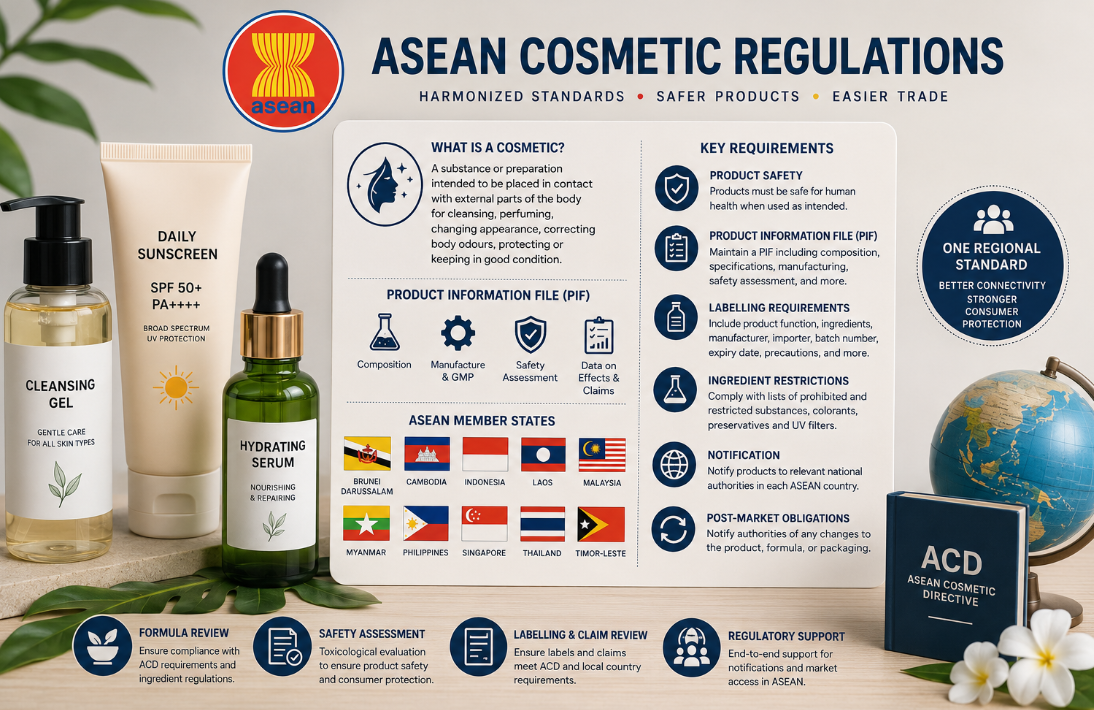

Southeast Asia has become one of the fastest-growing regions for cosmetic and personal care products. Rising consumer demand, expanding middle-class populations, and increasing interest in international beauty brands have transformed ASEAN into a highly attractive destination for cosmetic manufacturers seeking international growth.
However, entering multiple ASEAN countries requires careful regulatory planning. While the region has benefited from regulatory harmonization through the ASEAN Cosmetic Directive (ACD), companies must still understand local notification procedures, Product Information File requirements, ingredient restrictions, and post-market obligations to achieve successful market access.
For cosmetic brands seeking efficient expansion across Southeast Asia, understanding ASEAN cosmetic regulations is an essential first step.
Why ASEAN Is One of the Most Attractive Cosmetic Markets
The ASEAN region represents a combined market of hundreds of millions of consumers with rapidly growing demand for:
- Skincare products
- Haircare products
- Colour cosmetics
- Fragrances
- Personal hygiene products
- Natural and herbal cosmetics
- Premium beauty solutions
The region includes:
- Brunei Darussalam
- Cambodia
- Indonesia
- Laos
- Malaysia
- Myanmar
- Philippines
- Singapore
- Thailand
- Timor-Leste
Although each country maintains its own regulatory authority, the ASEAN Cosmetic Directive has significantly simplified market access by creating a harmonized framework for cosmetic products. This has reduced barriers to trade while maintaining high levels of consumer safety.
What Is the ASEAN Cosmetic Directive (ACD)?
The ASEAN Cosmetic Directive (ACD) came into force in 2008 and remains the foundation of cosmetic regulation across Southeast Asia.
The primary objectives of the ACD include:
- Harmonizing cosmetic regulations
- Facilitating trade between ASEAN countries
- Improving consumer protection
- Creating common ingredient requirements
- Standardizing notification procedures
- Aligning safety requirements
Before the introduction of the ACD, manufacturers often had to navigate significantly different regulatory systems in each country. Today, while local procedures still exist, many core requirements have been aligned across the region.
What Products Are Considered Cosmetics Under the ACD?
The ASEAN Cosmetic Directive defines cosmetics as products intended to come into contact with:
- The skin
- Hair
- Nails
- Lips
- External intimate areas
- Teeth
- Oral mucosa
for purposes such as:
- Cleaning
- Perfuming
- Changing appearance
- Correcting body odours
- Protecting the body
- Maintaining good condition
Typical cosmetic products include:
- Face creams
- Serums
- Makeup products
- Shampoos
- Conditioners
- Perfumes
- Oral care products
- Personal hygiene products
Products that fall outside this definition cannot generally be marketed as cosmetics under ASEAN regulations.
Herbal and Natural Products in ASEAN
Many ASEAN countries maintain separate categories for traditional or herbal products.
However, a product containing herbal ingredients can still be classified as a cosmetic provided that:
- Its intended use fits the cosmetic definition
- Claims remain cosmetic in nature
- No medicinal or therapeutic claims are made
This distinction is particularly important because herbal ingredients are extremely popular throughout Southeast Asian markets.
Product Classification Is Critical
One of the most important regulatory activities before entering ASEAN markets is determining the correct product classification.
Products making claims related to:
- Disease treatment
- Disease prevention
- Therapeutic effects
- Physiological changes
may no longer qualify as cosmetics.
Instead, they may be regulated as:
- Medicines
- Traditional medicines
- Health products
- Medical devices
Incorrect classification can result in notification delays, market-entry barriers, or regulatory enforcement actions.
Product Information File (PIF): The Core of ASEAN Compliance
One of the most important requirements under the ASEAN Cosmetic Directive is the Product Information File (PIF).
Unlike many regions where authorities require extensive pre-market submissions, ASEAN countries generally rely on manufacturers to maintain a complete and compliant PIF that can be reviewed by authorities when necessary.
The Product Information File typically contains:
Product Composition
A detailed description of ingredients and their concentrations.
For fragrances, this includes:
- Composition identification
- Supplier information
- Fragrance references
Raw Material and Finished Product Specifications
Technical information demonstrating product quality and consistency.
Manufacturing Information
Evidence that manufacturing processes comply with Good Manufacturing Practices.
Safety Assessment
Scientific evaluation of:
- Product safety
- Ingredient safety
- Toxicological profiles
- Exposure calculations
Undesirable Effects Information
Documentation relating to known adverse effects or safety concerns.
Claim Support
Scientific evidence supporting product performance and marketing claims.
A well-prepared PIF remains one of the most important regulatory assets for cosmetic companies operating within ASEAN markets.
Safety Assessment Requirements
Consumer safety remains a cornerstone of the ASEAN regulatory framework.
Manufacturers are expected to demonstrate that products are safe for their intended use through:
- Toxicological evaluations
- Ingredient reviews
- Exposure assessments
- Safety calculations
- Product-specific evaluations
Authorities may request safety documentation during inspections, audits, or investigations.
For this reason, professional cosmetic safety assessments are often considered essential before market entry.
Cosmetic Ingredient Restrictions
The ASEAN Cosmetic Directive includes extensive ingredient controls.
The ACD annexes contain lists of:
- Prohibited substances
- Restricted ingredients
- Approved preservatives
- Permitted colourants
- Approved UV filters
Manufacturers must ensure that formulations comply fully with these annexes before notification and commercialization.
Failure to comply may result in product rejection, recalls, or enforcement actions.
Labelling Requirements Under ASEAN Regulations
Product labelling plays a critical role in regulatory compliance throughout Southeast Asia.
The ACD requires cosmetic labels to include:
- Product function
- Ingredient list
- Manufacturer name and address
- Importer or distributor information
- Product quantity
- Batch number
- Expiry date when applicable
- Precautions for use
Although the core requirements are harmonized, individual ASEAN countries may introduce additional local labelling expectations.
For this reason, local label reviews remain an important part of compliance preparation.
GMP Compliance and Manufacturing Standards
Manufacturers placing products on ASEAN markets are expected to follow Good Manufacturing Practices (GMP).
GMP compliance supports:
- Product quality
- Manufacturing consistency
- Traceability
- Consumer safety
- Regulatory confidence
Authorities increasingly expect manufacturers to demonstrate robust quality management systems and documented production controls.
Product Notifications and Market Access
While the ACD harmonizes many requirements, cosmetic notifications remain managed by individual national authorities.
Each ASEAN country maintains its own notification procedures and administrative systems.
Although documentation requirements may vary slightly, the ACD ensures that most technical requirements remain broadly aligned across the region.
This creates significant efficiencies for companies planning multi-country expansion.
Managing Product Changes After Notification
Regulatory compliance continues after a product enters the market.
The ASEAN Cosmetic Directive requires manufacturers to notify authorities when significant product changes occur.
Examples include:
- Formula modifications
- Ingredient changes
- Packaging updates
- Label modifications
- Manufacturing changes
These requirements help authorities maintain oversight and ensure that product safety remains unchanged throughout the product lifecycle.
Why ASEAN Regulatory Expertise Matters
Although the ASEAN Cosmetic Directive has greatly simplified regional compliance, successful market access still requires expertise in:
- Product classification
- Product Information File preparation
- Formula reviews
- Ingredient compliance
- Safety assessments
- Label reviews
- Notification procedures
- Post-market obligations
For companies seeking expansion across multiple ASEAN countries, a strategic regulatory approach can significantly reduce approval timelines and compliance risks.
At CE.way, we help cosmetic manufacturers navigate ASEAN cosmetic regulations through formula reviews, Product Information File preparation, safety assessments, claim reviews, and compliance support across Southeast Asia, helping brands achieve efficient and successful market entry throughout the region.