










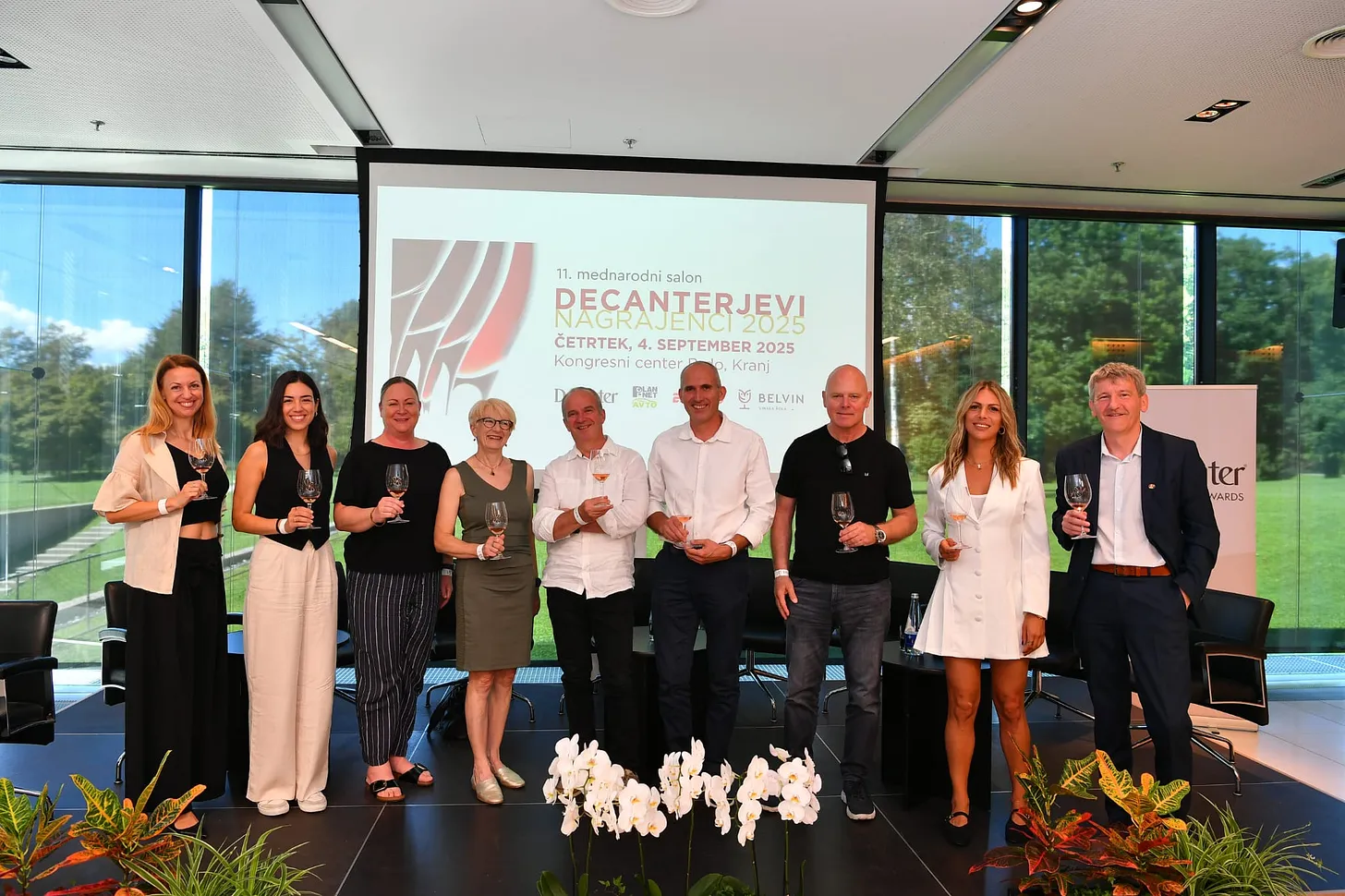

The 11th international Decanter Award Winners salon opened its doors. It was attended by award-winning winemakers at the Decanter World Wine Award, the largest wine competition in the world, renowned wine experts, evaluators and oenologists. They concluded that a real wine revolution has taken place in Slovenia in the last 20 years. Quality has risen, there has been a shift away from quantity, and winemaking knowledge is increasing. There is more trust in local and regional varieties, and Slovenian producers are moving from semi-dry wines to dry ones. Proof of this is Slovenia won a record 211 medals at the DWWA and ranked among the 15 most successful countries, as evidenced by the Best in Show award that Vinakoper Winery received this year. Their Slovenian wine has been selected as one of the 50 best in the world.
Renowned wine experts, judges, winemakers, and oenologists spoke at the press conference. “Now in its 22nd edition, the Decanter World Wine Awards (DWWA) is widely recognized as the largest and most influential wine competition in the world. It is supported by Decanter magazine, which provides unparalleled media exposure, explained Loukia Xinari, Head of Marketing at Decanter. “This year, 248 expert judges, including 22 Master Sommeliers and 72 Masters of Wine, judged wines from 57 countries, the most ever. Winning the DWWA is a global recognition that is appreciated by winemakers and consumers alike.”
“Since my first visit to Slovenia over 20 years ago, there has been a real wine revolution, firstly, in terms of quality and better winemaking knowledge. Slovenia is moving away from large volumes and semi-dry styles towards quality dry wines. I am impressed by the emphasis on a sense of origin. I see a more refined, subtle vinification that allows the grapes and the best vineyards to come to the forefront—without excessive interference from the winemaker (especially with the use of barrels or long maceration) to “add value,” commented Caroline Gilby, MW, a British wine expert. “It is also great to see that winemakers have more faith in local and regional varieties, as in the best cases they can offer world-class wines. Of course, this does not mean that international varieties are not important—we all know what a great Merlot, Sauvignon or Chardonnay should be, and if Slovenia can produce them well, that says a lot about the greatness of the terroir.”
“Slovenia achieved an extraordinary milestone at this year’s competition – winning a record 211 medals. Together with Croatia, it ranked among the 15 most successful countries, which is clear evidence of the superior quality of Slovenian wines. When I think of Slovenia, one key word comes to mind: quality. Slovenian winemakers have a unique advantage – creating top-notch wines that many markets and consumers around the world have not yet discovered,” added Beth Willard, Supreme Judge at the DWWA Awards. “This represents an extraordinary opportunity—not only for growth, but also for storytelling. Among the most recognizable specialties are Slovenian orange wines, which were particularly well represented at DWWA this year. Events like this salon are a great opportunity to introduce these unique styles to a wider audience and show the diversity, tradition and innovation that are at the heart of Slovenian winemaking.”
“This award was no coincidence – it is the result of years of focused work, bold decisions in the vineyard and cellar, and a clear vision. When the news came, the atmosphere in Vinakoper was electric. It was a historic moment – not just for us, but for the entire Slovenian wine industry,” shared Boštjan Zidar, Chief Enologist at Vinakoper, who received the Best in Show award at DWWA this year. “We made history—and you could feel it. A one-off success? Let’s be honest – winning the title of Best in Show is no small achievement and repeating or surpassing it is a serious challenge. But that is exactly where we are heading. We will continue to push the boundaries, with the ambition to win another major international award in the future—for Vinakoper and for Slovenia.”
“The fact that Vinoteka Klet Goriška Brda won three gold medals for red wines is the result of several factors, but the most important are the careful selection of vineyards and sophisticated vinification,” said Darinko Ribolica, chief oenologist at Klet Brda. “Over the years, we have carefully monitored all of our members and their vineyards. The quality in the vineyards has been constantly improving year after year, and over the past two decades, we have collected an incredible amount of data that has allowed us to evaluate each individual vineyard. From this long-term process, we have been able to precisely define which vineyards can be considered true ‘grand cru’ locations—and which ones cannot. We have selected exclusively these top locations for De Baguer wines, and the results speak for themselves. The path has been demanding, full of challenges and learning, but in the end we succeeded. These gold medals are not only a recognition of progress in vinification, but also a confirmation of a long-term vision that has its own.”
This year, seven Serbian wineries received a gold medal at the DWWA. Among them is Zvonko Bogdan Winery. Dragana Vasiljević, head of wine tourism at the winery, emphasized that since 2016, they have been regularly receiving awards at this prestigious competition. “It has already happened that all 7-8 registered wines in different categories were awarded—which is an exceptional confirmation of quality and a strong motivation for our team to continue raising standards. We are especially proud when certain wines show consistency and remain among the best in Serbia. This year, this award goes to our Merlot—a wine that we produce only in exceptional vintages. All three vintages were awarded at Decanter: the first with gold, the second with silver, and this year again with gold. This is proof that we are on the right track – that with each year we gain experience and progress. The love and dedication that our team invests in the vineyards and winemaking is clearly reflected in our wines.”
“I am not a medal collector by nature, but I am of course happy when our wines receive them,” said Miran Sirk, owner of Bjana Winery. “Of the 52 samples sent to DWWA from 2013 to 2025, since Bjana has been participating in the DWWA evaluation, 52 of our sparkling wines were awarded a medal. This is an incredible success, which shows the consistently high quality of all our sparkling wines. Slovenian sparkling wines have so far won eight prestigious titles (Platinum or Regional trophy) at DWWA, of which Bjana received five. Quality is not a privilege of the elite, but a great challenge. Every time, again and again.”
Robert Gorjak, director of the Belvin Wine School—a DWWA judge since 2005 and the event organizer—summed up that the salon was an exceptional opportunity for all wine lovers to taste more than 100 DWWA award-winning wines. “Good wine connects us. I am happy that so many people came. I want them to taste and drink wine. Wine is not just an alcoholic beverage; it is much more. It is part of our civilization and has a higher connotation and context.”
Additional information: Tonja Blatnik, iUFC- Institute for Universal Future Communications, 041 391161 Photo: Peter Irman

DWWA JUDGING
DWWA is famous for its strictly controlled and impartial judging, led by renowned international experts.
First phase: Wines are judged by region and style, in so-called “flights”. Regional Chairs oversee the work of the panels and re-taste all wines awarded a Silver or Gold Medal.
Platinum Selection: Wines awarded a Gold Medal (95-96 points) are re-tasted by the regional chairs and co-chairs, who decide on the Platinum Medals.
Best in Show: All Platinum wines are re-judged by the co-chairs, who select the 50 best wines in the world to be awarded the title of ‘Best in Show’. Each wine is judged on quality, style and regional character, ensuring a fair and credible assessment.
Caroline Gilby, MW, commented on the most common mistakes winemakers make when submitting their wines for DWWA judging. “Wines with flaws will never score well. The most common problem I see is oxidation or elevated volatile acidity, so careful wine handling and careful bottling are key. Balance and refinement are important—the best wines have real harmony, while wines where something is out of balance (for example, too much wood, too high alcohol content, too strong tannins, not enough acidity, etc.) will lose points. I encourage my judges to ask themselves before awarding it a medal: “Would you be happy to pour this wine and share it with a friend?” The wine needs to be more than just technically correct—it needs to be worthy of a medal, even for a bronze. For silver and gold medals, there needs to be something exciting about the wine— something you want to talk about and share.”
About the organizer: Belvin Wine School was founded in 2002. They are the only Slovenian APP (Approved Programme Provider) of the largest wine education institution, the Wine and Spirit Education Trust (WSET), which is based in London.
More about the event: https://www.belvin.si/en/events/event/salon-decanterjevi-nagrajenci-2025
Living the Tasty Life is a reader-supported publication. To receive new posts and support my work, consider becoming a premium subscriber.