










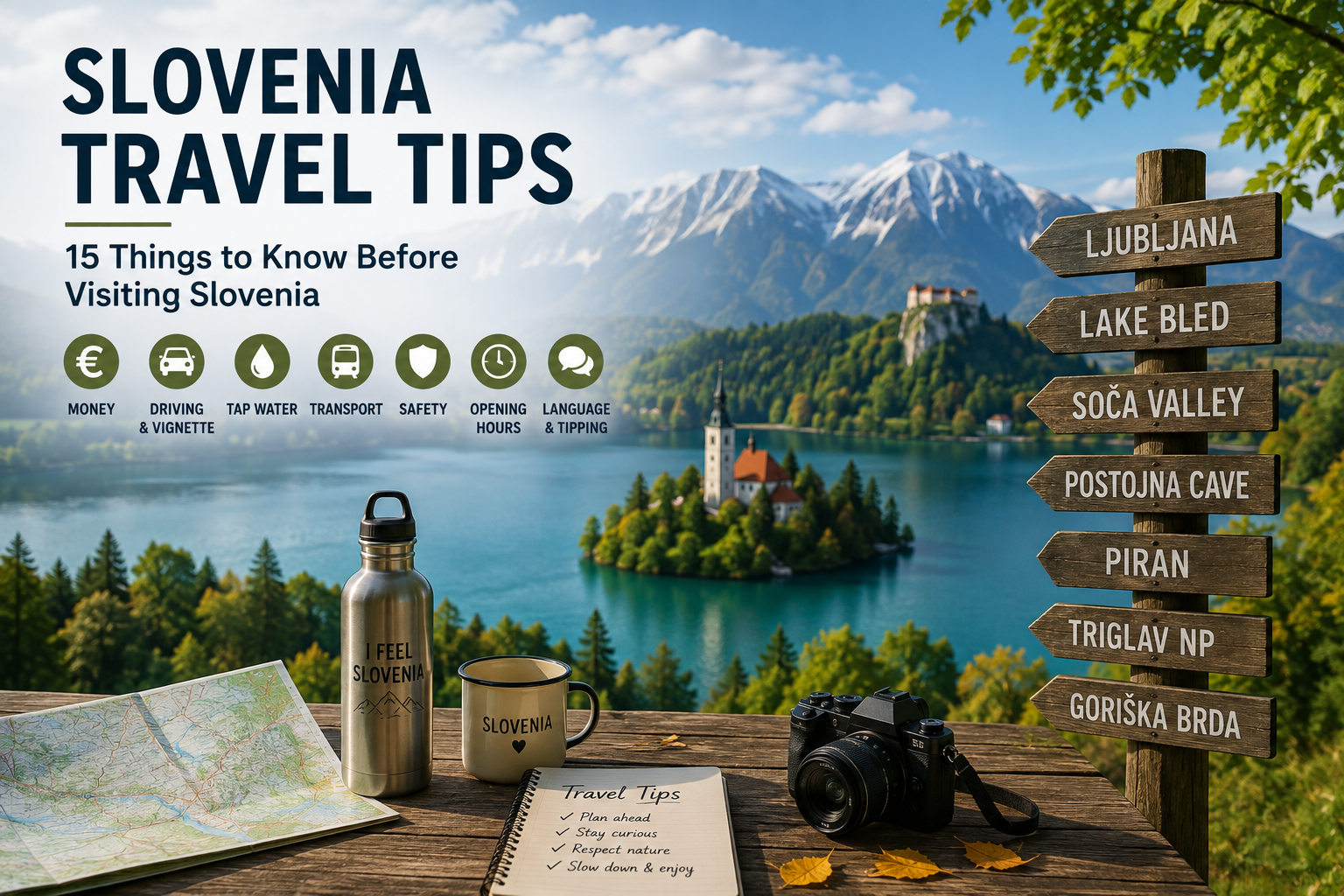

Planning your first trip to Slovenia? The country may be small, but knowing a few practical details before you arrive can make your trip considerably easier.
From driving and motorway vignettes to tap water, tipping, public transport, opening hours and emergency numbers, these are the Slovenia travel tips we would want every visitor to know before arriving.
Whether you are planning a weekend in Ljubljana, a road trip through the Julian Alps or a longer journey from Lake Bled to Piran, here are 15 essential things to know before visiting Slovenia in 2026.
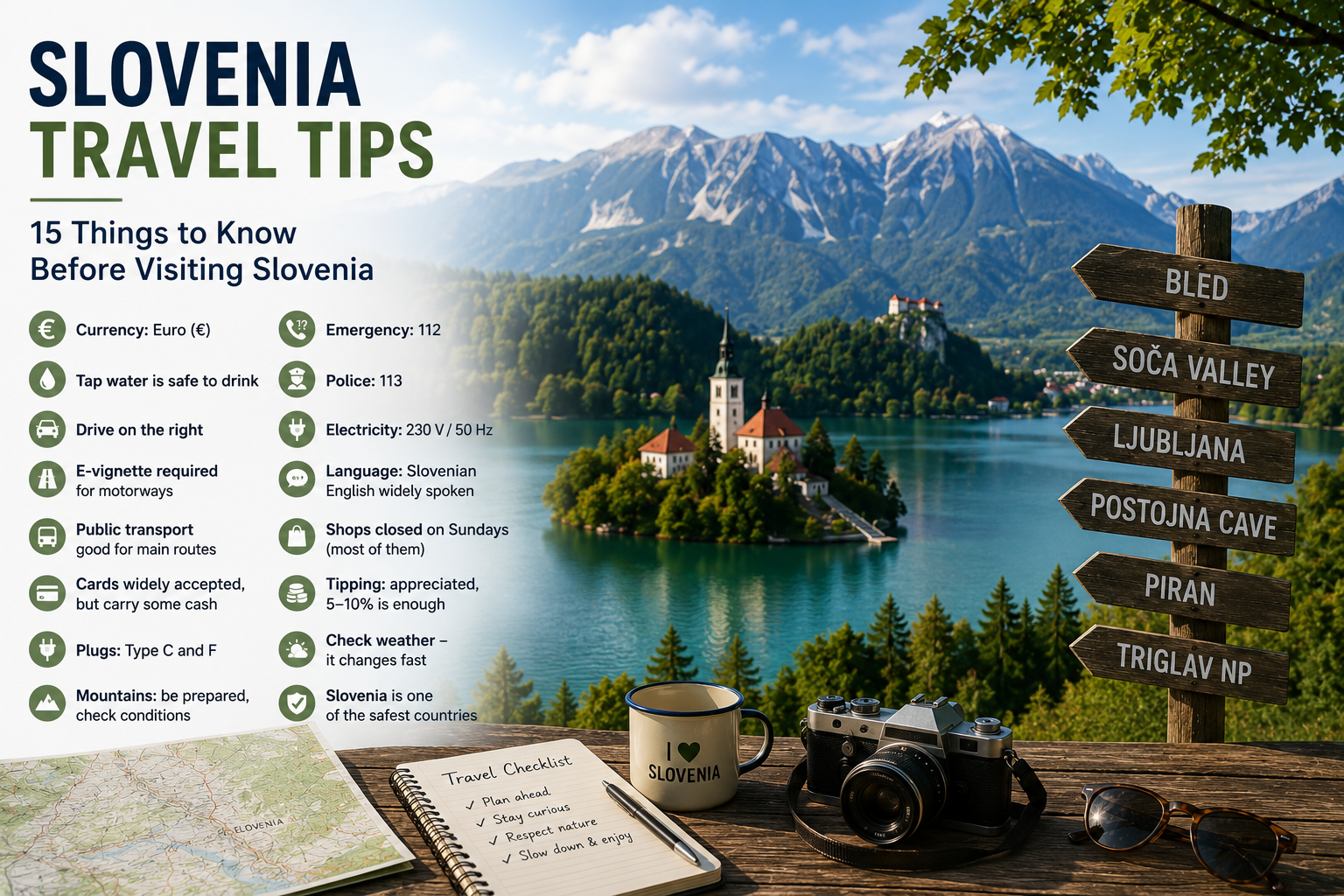
Slovenia travel tips at a glance
| Need to know | Quick answer |
|---|---|
| Currency | Euro (€) |
| Language | Slovenian; English widely spoken |
| Tap water | Safe to drink in normal conditions |
| Emergency | 112 |
| Police | 113 |
| Driving | Right-hand side |
| Motorways | E-vignette required for most vehicles up to 3.5 t |
| Electricity | 230 V / 50 Hz |
| Plugs | Type C and F |
| Sunday shopping | Most shops closed |
| Best transport | Car for flexibility; buses/trains for main destinations |

1. Slovenia uses the euro
Slovenia has used the euro (€) since 2007.
International credit and debit cards are widely accepted in hotels, restaurants, petrol stations and most shops, particularly in larger towns and tourist destinations. ATMs are also widespread.
That said, it is still useful to carry some cash.
Smaller mountain huts, countryside businesses, market stalls and some regional transport services may not offer the same payment options as central Ljubljana.
Our tip: carry one card plus approximately €30–€50 in cash rather than relying entirely on either method.
2. Yes, you can drink tap water in Slovenia
One of the easiest ways to save money and plastic while travelling around Slovenia is to refill your water bottle.
Tap water is generally safe to drink, and public drinking fountains can be found in many Slovenian towns and cities. Slovenia is also one of Europe’s most water-rich countries.
There is one sensible exception: after extreme weather or local problems, authorities can temporarily issue notices regarding a particular water supply.
For normal everyday travel, however, buying bottled water is usually unnecessary.
3. Slovenia is one of the safest countries in the world
Safety is one reason Slovenia works particularly well for solo travellers, couples and families.
According to the Slovenian Tourist Board’s current 2026 practical information, Slovenia ranks 4th globally among the world’s most peaceful countries and 3rd in Western and Central Europe.
Normal travel precautions still apply: look after valuables, lock your car and be careful in crowded tourist locations.
But violent crime against tourists is uncommon, and most visitors find Ljubljana, Bled, Piran and other Slovenian destinations comfortable to explore on foot.
We have more on this in our guide to why Slovenia is one of the world’s safest countries. Read our Slovenia safety guide
4. Check Slovenia’s entry requirements before travelling
Slovenia is part of the European Union and the Schengen Area.
EU citizens can enter Slovenia using a valid passport or national identity card and do not need a visa for a normal tourist visit. Rules for travellers from outside the EU depend on nationality and visa status. Short Schengen stays are generally limited to 90 days within any 180-day period.
There is an important change for visitors from outside the EU in 2026.
The EU’s new Entry/Exit System – EES became fully operational on 10 April 2026 and digitally records short-stay border crossings by non-EU nationals.
As of September 2026, ETIAS is not yet operational. The EU currently expects it to launch in the last quarter of 2026, so travellers visiting later in the year should check the official EU information before departure.

5. If you drive on Slovenian motorways, understand the e-vignette
This is probably the most important Slovenia driving tip for foreign visitors.
Most cars and other vehicles weighing up to 3.5 tonnes need an electronic vignette to use Slovenian motorways and expressways.

There is no physical sticker. The e-vignette is linked to your registration number, so entering the plate incorrectly can mean you do not have a valid toll payment.
For a typical passenger car in toll class 2A, the official 2026 prices are:
- 7 days – €16
- 1 month – €32
- 1 year – €117.50.
Buy from the official DARS e-vignette website, particularly because DARS has warned travellers about unauthorised online sellers. Official Slovenian e-vignette shop
A useful 2026 change
Since 1 January 2026, an e-vignette is no longer required on the H5 and H6 coastal expressway sections.
6. You do not necessarily need a rental car
A car is the easiest way to reach remote valleys, vineyards, mountain trailheads and small villages, but it is absolutely possible to travel around much of Slovenia without one.
Buses and trains connect Ljubljana with most major towns and popular destinations.
Slovenian Railways allows travellers to buy tickets online or through the Grem z vlakom mobile app, while Ljubljana Bus Station provides online timetables and ticket sales for many bus routes.
For Bled, Maribor, Celje, Postojna and many other destinations, public transport can be perfectly practical.
For rural Slovenia, however, a car gives you considerably more freedom.
We have a dedicated guide covering buses, trains, Ljubljana transport and IJPP tickets. Guide to Public Transportation in Slovenia in 2026
7. Always check the return journey before a day trip
This is one of those Slovenia travel tips that can save you several hours of frustration.
Public transport between larger towns may be frequent during the day, while evening, Sunday and holiday connections can be less frequent.
Do not simply check how to reach your destination.
Check:
Ljubljana → Bled
and
Bled → Ljubljana
before leaving.
For trains, Slovenian Railways specifically advises passengers to check current timetables, delays, disruptions and replacement buses before travelling.
This becomes even more important for destinations such as Velika Planina, Bohinj, Kamniška Bistrica or smaller wine villages.

8. Shops are usually closed on Sundays
This surprises quite a few international visitors.
Most Slovenian shops are closed on Sundays, although essentials remain available at some petrol stations and certain exempt stores.
Typical shop hours during the week and Saturday are broadly between 7:00/9:00 and 19:00/21:00, although individual businesses set their own schedules. Museums often close on Mondays.
If you arrive at an apartment late on Saturday and want groceries for Sunday morning, shop before checking in.
Restaurants, cafés and tourist attractions follow their own opening schedules and are often open on Sundays.
9. Tipping is appreciated, but it is not American-style tipping
You do not need to automatically add 20% to every restaurant bill.
In Slovenia, tipping is generally optional.
Many locals simply round up the bill. In a restaurant with particularly good service, something around 5–10% is a reasonable gesture rather than a strict rule. Slovenian research into tipping habits has likewise found relatively modest tipping levels compared with countries where gratuities form a major part of service workers’ income.
At cafés and in taxis, rounding up is perfectly normal.
So if your coffee costs €4.60, paying €5 is absolutely fine.
10. English will get you surprisingly far
The official language is Slovenian – slovenščina.
But international visitors usually find communication straightforward. Slovenia’s official tourism portal notes that most people speak English, particularly useful in tourism, restaurants, hotels and among younger Slovenians.
Still, learning four words goes a long way:
Dober dan – Good day / Hello
Prosim – Please / You’re welcome
Hvala – Thank you
Na zdravje – Cheers
And yes: Slovenia and Slovakia are two completely different countries.
Locals have heard that one before.
11. Slovenia’s weather can change dramatically within a single trip
Do not pack for Slovenia as if the entire country has one climate.
Within only a few hours you can move between the Adriatic coast, Alpine mountains and continental lowlands.
The mountains have an Alpine climate, the coast is influenced by a sub-Mediterranean climate, and north-eastern Slovenia has a more continental climate.
That means the answer to “What should I pack for Slovenia?” is usually:
layers.
Even in summer, bring a light rain jacket and something warmer if visiting the mountains.
If you are travelling this month, see our complete guide to Slovenia in September 2026, including weather and packing advice.
12. Do not underestimate the Slovenian mountains
Slovenia looks small on a map, but the Julian Alps and Kamnik-Savinja Alps are real mountain environments.
A sunny morning in Bled does not guarantee good conditions at 2,000 metres.
Weather can change rapidly, trails may be exposed and higher-altitude routes can encounter cold temperatures or snow outside the main summer period.
If you go hiking:
- check the weather,
- check trail conditions,
- wear appropriate footwear,
- carry water,
- start early,
- and choose a route suitable for your experience.
If something goes wrong, mountain rescue is reached through 112.
13. Save these two numbers: 112 and 113
Hopefully you will never need them.
But every visitor should know:
112 – emergency medical assistance, fire and rescue services
113 – police emergency number
The European emergency number 112 works 24 hours a day and is the number to use for medical emergencies, firefighters, mountain rescue and other rescue services.
Slovenia’s international telephone code is +386.
Save 112 in your phone before heading into the mountains.
14. Bring the right plug – but internet access is easy
Slovenia uses 230 V electricity at 50 Hz and European Type C and F sockets with two round pins.
Travellers from the UK, US and countries using different plug systems will generally need an adapter.
Mobile coverage is widespread, with 4G and some 5G coverage, while hotels, cafés and restaurants commonly provide Wi-Fi. Prepaid Slovenian SIM cards are also readily available.
For most European visitors, roaming works as it would elsewhere in the EU, depending on their mobile plan.
15. Do not try to see the entire country in three days
Yes, Slovenia is compact.
And yes, you really can reach the Alps, caves, vineyards and Adriatic coast within relatively short driving distances.
But that does not mean you should spend your holiday constantly changing hotels and sitting in a car.
For a first visit, a much better plan is usually:
2–3 days Ljubljana
2 days Bled/Bohinj
1–2 days Soča Valley or wine country
1–2 days Piran and the coast
Ljubljana also works extremely well as a base because many major destinations can be visited in a single day.
See our guide to the best day trips from Ljubljana for travel times and itinerary ideas. Best Day Trips from Ljubljana – Explore Slovenia in 1 Day
Bonus Slovenia travel tip: arrive hungry
Slovenian food is influenced by the Alps, Mediterranean, Pannonian Plain and neighbouring Italy, Austria, Hungary and the Balkans.
Do not spend the entire trip eating pizza just because it is familiar.
Try:
štruklji,
Idrijski žlikrofi,
Kranjska klobasa,
jota,
potica,
prekmurska gibanica,
and of course Blejska kremšnita when visiting Bled.
Start with our guide to the country’s most famous dishes. TOP 10 Slovenian Dishes You Must Try
Frequently asked questions about travelling to Slovenia
Is Slovenia expensive to visit?
Slovenia is generally less expensive than some neighbouring Alpine destinations, although Ljubljana, Lake Bled and the coast can be considerably more expensive during peak periods. Accommodation is usually the biggest variable.
Can you drink tap water in Slovenia?
Yes. Tap water is normally safe to drink, and public drinking fountains are available in many towns.
Do I need cash in Slovenia?
Cards are widely accepted, but having a small amount of euro cash is useful for smaller businesses, markets, mountain areas and certain transport situations.
Do people speak English in Slovenia?
Yes. English is widely spoken, particularly among younger people and in tourism.
Do I need a vignette to drive in Slovenia?
If you use Slovenian motorways or most expressways with a vehicle up to 3.5 tonnes, you generally need an e-vignette. The major 2026 exception is the H5/H6 coastal expressway, where the vignette requirement ended on 1 January 2026.
Is Slovenia safe for solo travellers?
Slovenia ranks among the world’s safest and most peaceful countries and is generally considered an excellent destination for solo travel.
How many days do you need in Slovenia?
Seven days is a good first visit. Ten to fourteen days allows you to travel much more slowly and include the Alps, coast, wine regions, caves and smaller towns.
Before visiting Slovenia: remember these five things
If you remember nothing else from this guide, remember:
Drink the tap water.
Buy the correct e-vignette before entering a motorway.
Check your final bus or train home.
Save 112 in your phone.
And perhaps most importantly:
do not rush Slovenia.
The country’s greatest advantage is not simply that everything is close together. It is that within a relatively small area you can experience Alpine lakes, Mediterranean towns, vineyards, caves, forests and one of Europe’s most charming capitals.